
The first twelve: The Leadership Dozen. The reading notes: The Leadership Dozen: Reading Notes.
Twelve finished, twelve more
In September I bought twelve books for the intelligence era and promised to read them all and write down what they taught. All twelve are now finished, and the reading notes carry the full account: ten lessons, eight early signals, and an evidence test any leader can take into a meeting about an AI deployment.
A reading discipline is not a project with an end date. It is a habit, and the habit needs its next set of books. So here is the next dozen, chosen the same way as the first and aimed one step earlier in the story.
From evidence to the decisions before it
The first dozen was about evidence. Again and again, someone had the uncomfortable fact, and an institution chose the comfortable account instead. A famous name stood in for a check. A score stood in for judgment. A warning that had been true too often stopped sounding like a warning.
Reading those books, I kept noticing that the failure began earlier than the evidence. Before evidence can show whether a system is working, someone has already decided what success means, what gets measured, who holds authority, and which consequences count. By the time the dashboard turns green, those choices are built into it.
That is the subject of the next twelve. Not only how systems fail, but how the decisions made before any evidence exists shape what an organization is able to see, and therefore what it is able to fix. It is the question every leader deploying AI agents faces right now, because every agent carries someone’s definition of a good outcome.
How the next dozen was chosen
Narrative first. Reconstructed true events teach judgment in a way a framework cannot, so every book on this list tells a real story with real people making real decisions. Books of argument and philosophy, however good, went to the reading list beside the dozen rather than into it.
One book about AI on its face. The same rule as the first dozen. The consequential questions about AI are about power, trust, institutions and incentives, and those are easier to see in a story about something else.
Recent. All twelve were published in 2025 or 2026, so the reporting reflects the world as it is now.
At least one success. The first dozen leaned heavily on what goes wrong. A thesis that only ever studies failure stops being tested. This dozen includes two stories of organizations built well, chosen on purpose, so the lessons are about how to build as well as how to catch.
The three-question test
I will read every book with the same three questions, and the notes will answer them.
- What did the organization optimize for?
- What did that optimization make invisible?
- What decision would I change in a business I am building?
The third question is the one that matters. Input without action is a shelf. Action without input is a gamble.
Movement one: who decided what success means
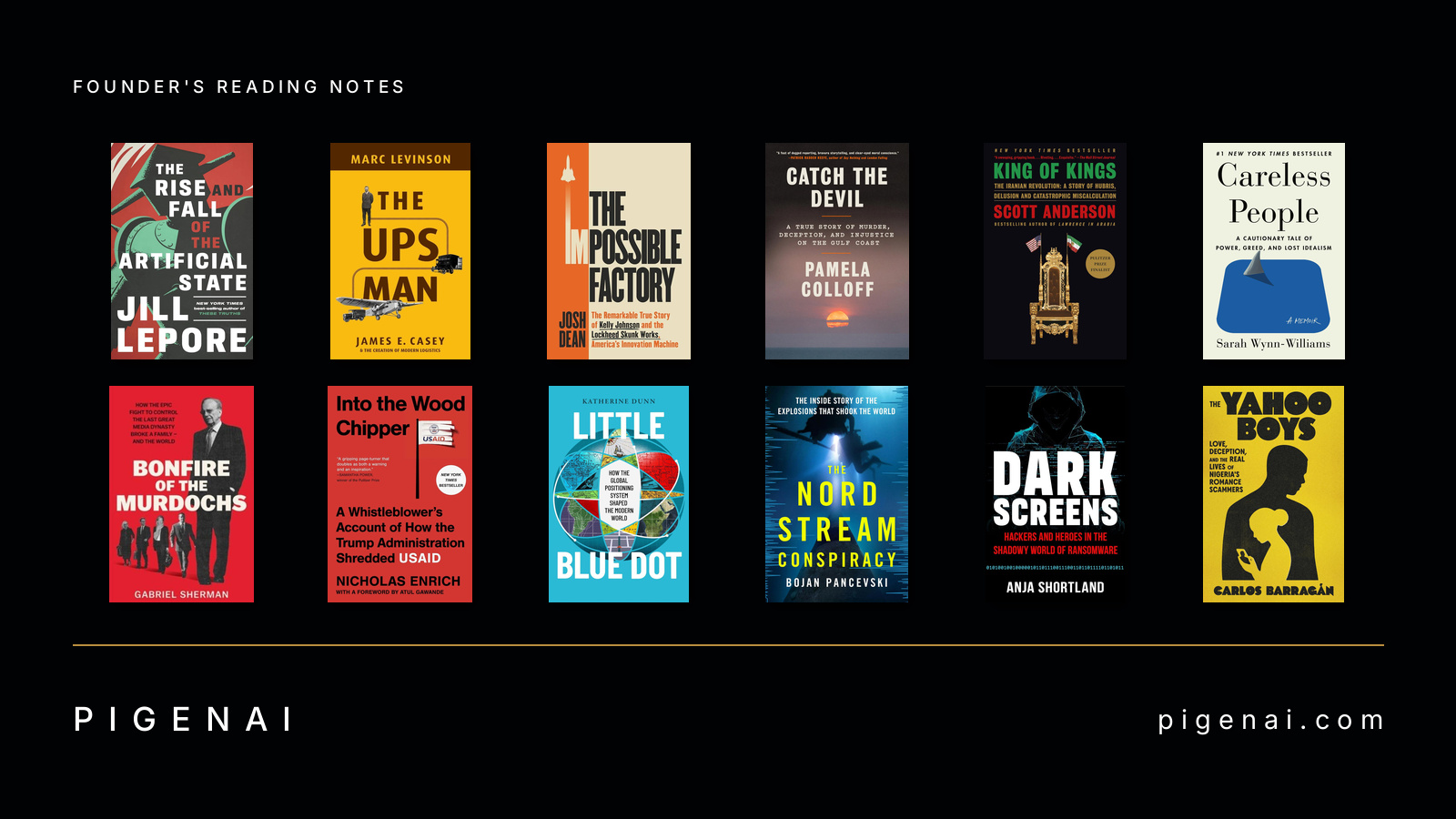
The Rise and Fall of the Artificial State, by Jill Lepore. This is the one book about AI on its face, and it is a history rather than a forecast. Lepore traces how the people who controlled data technology set out to replace deliberation with automated sorting, and where they got their ideas. I chose it because every system that sorts people carries assumptions about what a good result looks like, and those assumptions were chosen by someone long before the system was switched on.
The UPS Man, by Marc Levinson. The success story, chosen on purpose. Levinson tells how James E. Casey built a small delivery business into the company that defined modern logistics, through relentless measurement and operating discipline, with the compromises of that history left in. I want to understand what makes trustworthy performance repeatable after the founder stops making every decision.
The Impossible Factory, by Josh Dean. The story of Kelly Johnson and Lockheed’s Skunk Works, where a small team designed some of the most advanced aircraft of the twentieth century at astonishing speed. It is the constructive companion to Unit X from the first dozen. I chose it to study how a small team moved fast without giving up proof that the thing actually worked.
Catch the Devil, by Pamela Colloff. A con man who repeatedly told prosecutors that fellow inmates had confessed to him, and a justice system that kept using his testimony because it closed cases. I chose it because it shows what happens when the measure of success is a closed file rather than the truth, a pattern that applies directly to any system graded on tickets resolved.
Movement two: what the dashboards could not see
King of Kings, by Scott Anderson. The fall of the Shah of Iran in 1979, told as the collapse of a regime that every conventional measure said was secure. Anderson contrasts what the palace and foreign intelligence agencies believed with what was happening in the streets. I chose it as the purest case on the shelf of a dashboard measuring the wrong things.
Careless People, by Sarah Wynn-Williams. A former senior Facebook policy executive’s account of how decisions were made at the top of a global platform. Meta disputes substantial parts of it, so I will read it as one insider’s testimony beside the company’s response. I chose it for the governance question at its center: what happens when internal dissent cannot meaningfully constrain the people in charge.
Bonfire of the Murdochs, by Gabriel Sherman. The succession fight inside the Murdoch media empire, centered on an attempt to change a family trust that had been designed to be irrevocable. I chose it because it tests whether a carefully designed guardrail survives the person who created it deciding to rewrite it.
Into the Wood Chipper, by Nicholas Enrich. A career official’s account of the rapid dismantling of USAID and what happened to the programs it ran. I chose it for the operational question every leader faces when cutting or automating legacy systems: whether anyone mapped what those systems were holding up before pulling them out.
Movement three: what a small actor can do to a large dependency
Little Blue Dot, by Katherine Dunn. The history of GPS, from a military satellite project to the invisible positioning and timing signal underneath modern life. I chose it because AI is becoming the same kind of utility, one that everything else quietly assumes will always be there.
The Nord Stream Conspiracy, by Bojan Pancevski. A reconstruction of the sabotage that destroyed the Nord Stream pipelines in 2022 and the investigation that pieced it together. Chokepoints in the first dozen showed how large powers use indispensable nodes. This book shows how a small, determined team can sever one, and how patient investigators established what actually happened.
Dark Screens, by Anja Shortland. Published in the UK as We Know You Can Pay a Million. Shortland, an economist at King’s College London, takes the reader inside the most consequential ransomware attacks of this century, the criminal groups that run them like businesses, and the people and organizations working to stop them, from NotPetya and WannaCry to attacks on hospitals and public infrastructure. I chose it to understand the attacker’s economics as well as the defender’s, including how a victim’s own preparations can signal what it is willing to pay.
The Yahoo Boys, by Carlos Barragán. Immersive reporting on romance scammers in Lagos, the people they targeted, and the economy behind the deception. I chose it for its most unsettling finding: some victims kept sending money after they knew the truth, because the story met a need the facts could not. It is the hardest question on the shelf for anyone who thinks a human in the loop is automatically a safeguard.
Eight ideas for leaders in the intelligence era
These are the ideas I expect this dozen to sharpen. I am naming them now so the notes can test them, and so any leader reading along knows what to watch for. Each one matters to a chief executive, a CISO or a board deciding how far to trust an AI system with real work.
1. The decision before the evidence. Every system carries a definition of success that someone chose before it was switched on. For organizations, the most important governance document for an AI agent is a plain statement of what it is optimizing for and who owns that choice.
2. The measure that replaces the mission. A number chosen to track a goal can quietly become the goal. Leaders keep measures honest by pairing every target with a direct look at the outcome it was meant to represent.
3. Speed with proof. The fastest teams in history built the test into the work. AI makes iteration cheap, and the organizations that benefit most will be the ones that let reality grade each version.
4. The filtered dashboard. Reporting chains are built to summarize, and summaries remove the inconvenient signal. Every leader needs at least one channel to the ground truth that does not pass through the people being measured.
5. Guardrails that hold for everyone. A rule protects an institution only if it binds the people with the most authority. That includes the authority to change what an AI system is allowed to do.
6. The load bearing system nobody mapped. Some of the most valuable work in an organization is invisible until it stops. Before automating or retiring a process, map what it was quietly holding up, and plan for the day an invisible utility is unavailable.
7. Asymmetry. A small, determined actor can disrupt a large, concentrated dependency, and AI lowers the cost of trying. Resilience comes from redundancy, rehearsed recovery and knowing which single points of failure matter most.
8. Belief that outlasts the evidence. People keep trusting an answer that meets a need, even after the facts arrive. A human in the loop is a real safeguard when that person is independent of the outcome they are approving.
Together they describe the work of leadership in this era: deciding well before the evidence exists, and building organizations that can see clearly once it does.
What this dozen asks about AI
The first dozen taught me to ask for the artifact before accepting the attestation. This one asks the question underneath it. Who wrote the definition of success that the artifact will be judged against, and what did that definition leave out?
Every AI deployment carries those choices: what the system optimizes for, which outcomes count, who can override it, and which costs never appear on its dashboard. Those choices are made before the first evidence exists. The leaders who get them right will not need to be rescued by the evidence later.
Six more on the shelf
Twelve is not nearly enough, and a few books nearly made the list. They may well become the third dozen. Apple in China by Patrick McGee, on how efficiency became dependency, which I have already read and which helped shape this list. The Score by C. Thi Nguyen, the best short book I know on how metrics replace the values they were meant to measure. Hyperscale by Paris Marx, on the physical cost of data centers. London Falling by Patrick Radden Keefe, on how far an invented identity can travel. The Spy in the Archive by Gordon Corera, on the archivist who quietly copied a secret service’s files for twelve years. And The Curious Case of Mike Lynch by Katie Prescott, on the story a technology company tells about its own success.
The notes on each book will follow here as I finish them, answering the three questions. If you have read any of these, I would like to know which one you would hand a board first.
The next dozen
- The Rise and Fall of the Artificial State, by Jill Lepore. How automated sorting came to replace deliberation.
- The UPS Man, by Marc Levinson. How measurement and discipline built something that lasted.
- The Impossible Factory, by Josh Dean. Speed with proof that the thing works.
- Catch the Devil, by Pamela Colloff. When a closed case counts as success.
- King of Kings, by Scott Anderson. Every measure said stable; the street said otherwise.
- Careless People, by Sarah Wynn-Williams. When dissent cannot constrain authority.
- Bonfire of the Murdochs, by Gabriel Sherman. A founder and the guardrail he built.
- Into the Wood Chipper, by Nicholas Enrich. Cutting systems before mapping what they hold up.
- Little Blue Dot, by Katherine Dunn. The invisible utility everyone assumes is permanent.
- The Nord Stream Conspiracy, by Bojan Pancevski. A small team and a strategic chokepoint.
- Dark Screens, by Anja Shortland. The attacker’s economics.
- The Yahoo Boys, by Carlos Barragán. When the story outlasts the truth.
Related: The Leadership Dozen: Twelve Books for the Intelligence Era, The Leadership Dozen: Reading Notes and Evidence Over Attestation, Part One.