Why the tollbooth, not the traveler, wins in an age of economic warfare
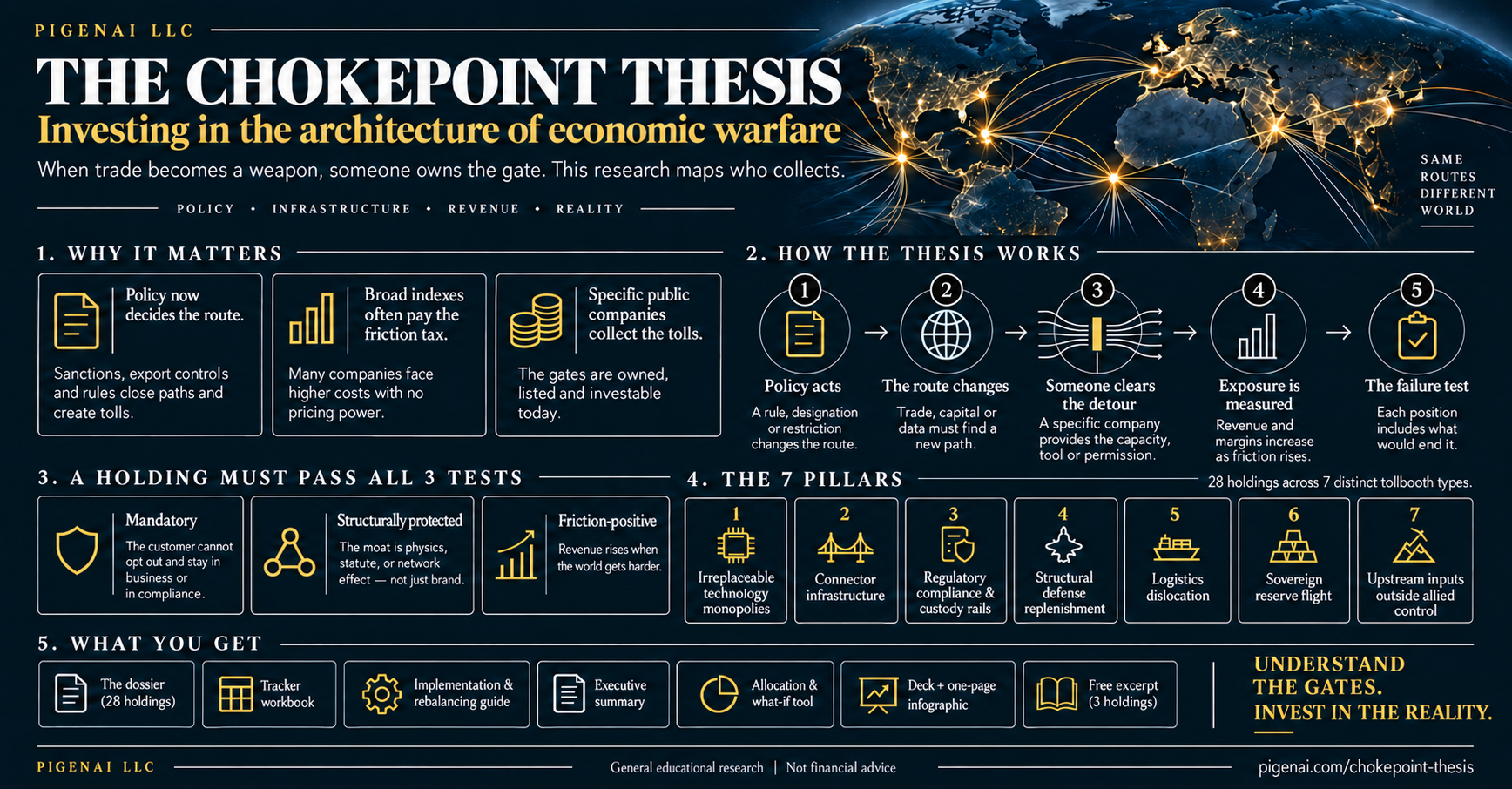
In an age of economic warfare the decisive question is not who makes a thing but who controls the point it has to pass through. Those control points, the tollbooths, run across the supply chains for energy, technology and finance, and they reach into every country and every market that depends on them. This research names them, sorts them into the pillars of value they sit on, and asks what holds each pillar up and what would take it away.
For most of my career I worked on the plumbing that connects things: voice networks at AT&T Bell Labs, IP telephony and video at Cisco, the network ecosystem at Intel. The lesson that plumbing teaches, over and over, is that value pools at the point of interconnection. Whoever owns the switch, the standard or the right of way ends up with pricing power the endpoints never get. It took me longer than it should have to see that the same lesson applies to geopolitics.
Edward Fishman's Chokepoints gave me the vocabulary. His account of how the United States and its allies learned to use dollar clearing, export controls and maritime insurance as instruments of statecraft is the best explanation I have read of how power moves in the modern economy. It is also, read from a different angle, a map of where the interconnection points are. I could not stop reading it as an investor.
Every chokepoint has two sides. On one is the party being coerced. On the other is the party that owns the gate. Almost all of the public conversation is about the first side.
Consider what happens when a government decides advanced chips must not reach a rival. New fabs get built in Arizona, Dresden and Kumamoto at enormous cost, often subsidized, carrying yield risk in unfamiliar facilities and demand that may not arrive on schedule. Meanwhile every one of those fabs buys the same lithography scanners from the same company, the same inspection tools from the same two or three vendors, and licenses the same design software from the same duopoly. The gatekeepers are paid whichever side wins, and they are paid twice when the world decides it needs two of everything.
The pattern repeats wherever economic coercion is practiced. When crude is rerouted from Europe to India, the oil still moves; it simply travels three times as far, and the compliant tanker fleets earn a premium for the distance. When ownership rules tighten, every bank must query the same handful of registries, and those vendors have a customer that is legally forbidden from leaving. When reserves are frozen, central banks that watched it happen buy assets that cannot be frozen, and the royalty companies sitting on gold production get a bid they did not have to earn.
I want to be careful about what I am not saying. I am not saying any of these companies is cheap today, or that the trend runs indefinitely. The opposite. The most important idea in Fishman's book, for an investor, is that using a chokepoint teaches the target to build around it. Leverage decays. A tollbooth is a wonderful asset right up until someone finishes the bypass, and the history of sanctions is a history of bypasses. So the question is never only who owns the gate. It is how long the gate will matter, and what would tell me early that it is starting not to.
That is the discipline I tried to bring to this research. Seven pillars, because seven is how many structurally distinct kinds of tollbooth I could identify with confidence, and the seventh is the one that pays when the other six are under pressure. Twenty-eight liquid, publicly traded instruments, every one of them tradable on a US exchange or, where the company has no US listing, through the depositary line named in the row. A thesis you cannot act on is a book review. A core-satellite structure with written rebalancing rules, because a plan you cannot write down is a mood. And an early-warning signal for each pillar, because the day the thesis stops working will not announce itself, and I would rather have decided in advance what I am watching for.
I built this for myself first. I am publishing it because the framework seems more useful shared than kept, and because the people I most want to hear from are the ones who will tell me where it is wrong. If you work in compliance, in trade logistics, in defence procurement or in a central bank treasury, you know things about these gates I can only infer from outside. The free teaser has the full argument. I hope you will read it and argue with me.